Centre dentaire Vadeboncoeur Book an Appointment

Restorative dentistry
in Gatineau

Repairing your teeth to preserve your smile

A tooth that is decayed, cracked, worn or weakened does not necessarily have to be lost. Restorative dentistry aims to repair a damaged tooth, restore its function and preserve as much of your natural dentition as possible.

At Centre dentaire Vadeboncoeur in Gatineau, our team assesses your situation and explains the different options that may suit you, from white fillings to crowns, inlays and dental bridges.

Our approach is simple: understand the problem, explain the possibilities to you and choose a solution with you that suits your dental health.

Smiling patient after a dental restoration

White fillings

Repairing a decayed or damaged tooth

When decay or minor deterioration affects a tooth, a restoration can repair the damaged portion and give the tooth back its shape and function.

White fillings, also called composite restorations, are designed to blend with the natural colour of your teeth. They make it possible to restore a tooth discreetly.

Depending on your situation, a white filling may be used to:

  • Treat certain cavities
  • Repair a slightly broken or chipped tooth
  • Replace certain existing restorations
  • Restore a worn or damaged part of a tooth

Your dentist will assess the extent of the damage in order to determine whether a filling is the appropriate restoration or whether another solution should be considered.

Dentist explaining white fillings to a patient
Strengthening

Dental crowns and inlays

Strengthening a weakened tooth

When a tooth is too damaged to be restored adequately with a simple filling, a dental crown or an inlay may be considered.

The choice between a filling, an inlay and a crown depends on several factors, including the amount of remaining tooth structure and the overall condition of the tooth. Your dentist can explain the advantages and considerations specific to each option.

The dental crown

A crown covers the visible part of a tooth in order to give it back its strength, its function and a natural appearance.

It may be recommended when a tooth is heavily restored, broken or weakened, or has undergone certain treatments.

The dental inlay

An inlay makes it possible to restore a larger portion of a tooth when the situation does not lend itself to a conventional filling, without necessarily having to cover the entire tooth as a crown would.

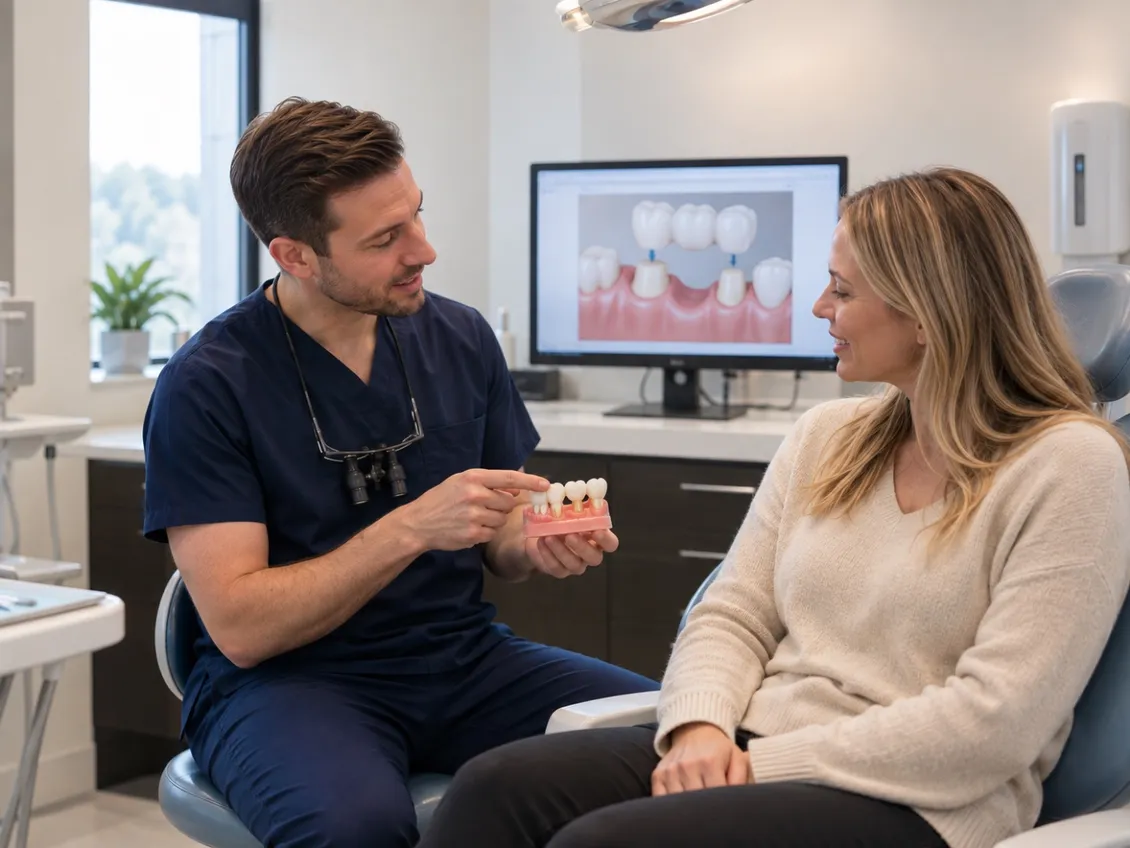
Dentist showing a dental bridge model to a patient

Dental bridges

Replacing a missing tooth

When one or more teeth are missing, a dental bridge is one of the solutions that may be considered to fill the space they have left.

A conventional bridge generally uses the adjacent teeth as support in order to hold one or more replacement teeth.

The aim is to restore proper function and the appearance of your smile, while taking your dentition as a whole into account.

Depending on your situation, other replacement solutions, including dental implants, may also be considered.

Your dentist can review the different options with you and explain which one best matches your oral health, your needs and your situation.

Our approach

Preserving your natural teeth whenever possible

Restorative dentistry is not simply about repairing what is visible. The aim is to find a solution that restores the function of the tooth while preserving as much of its natural structure as possible.

That is why the recommended treatment can vary considerably from one situation to another. A small cavity may call for a filling, whereas a more weakened tooth might benefit from an inlay or a crown. And a tooth that cannot be saved may eventually need to be replaced.

Our team takes the time to show you what it observes and to explain why a treatment is recommended.

Frequently asked questions

Frequently asked questions about restorative dentistry

A filling generally restores a limited portion of a tooth, whereas a crown covers a larger part of the tooth in order to protect it and give it back its strength. The choice depends mainly on the condition of the tooth and the amount of healthy structure remaining.

An inlay may be considered when a tooth requires a more substantial restoration than a conventional filling, but a full crown is not necessary. Your dentist can determine the appropriate solution after examining the tooth.

A conventional bridge generally relies on the adjacent teeth to replace a missing tooth. A dental implant instead replaces the root of the missing tooth and supports a restoration. The two solutions have different characteristics, and an assessment makes it possible to determine the options suited to your situation.

Contact our team so the tooth can be assessed. Even in the absence of significant pain, a broken restoration or a damaged tooth may require treatment in order to prevent the situation from getting worse.

Do you have a tooth that needs repair?

A cavity, a broken tooth, a damaged old restoration or pain does not necessarily mean you are going to lose your tooth. At Centre dentaire Vadeboncoeur in Gatineau, we begin by establishing a diagnosis and assessing the possibilities available to you. Whether your situation calls for a white filling, an inlay, a crown or the replacement of a tooth, we clearly explain the recommended care before proceeding. We are accepting new patients, and our care is offered in English and French.

Is a tooth worrying you? Have it assessed.